
In the modern digital workflow, file format conversion is no longer a luxury—it is a daily necessity. From marketing teams repurposing video assets to developers needing quick JSON-to-CSV transformations, the right converter can save hours of manual labor. Yet, amid hundreds of free online tools and desktop applications, a pressing question remains: What actually makes a format converter “professional”?
This article does not aim to crown a single “best” tool—such a claim would ignore the nuance of different use cases. Instead, we will objectively analyze the core criteria for professional-grade performance, compare key players in the market, and outline when a high-end tool is worth the investment versus when a free utility is sufficient.
H1: Format Converters: A Professional Standard vs. Free Convenience
H2: The Real Definition of “Professional” in File Conversion
Before diving into specific software comparisons, we must separate marketing buzzwords from measurable engineering standards. A professional-grade converter is not merely one that supports many file extensions. True professionalism is defined by four pillars:
1. Fidelity and Lossless Output
When a designer exports a 4K ProRes file, they expect pixel-perfect results. A professional converter must maintain bitrate, color space (HDR, Rec. 709), and audio channels without recompression artifacts. Free online tools often strip metadata or down-sample audio to reduce server load, which is unacceptable for broadcast or print deliverables.
2. Batch Processing and Automation
Professionals do not convert one file at a time. Look for command-line interface support (for developers) or drag-and-drop batch queues that allow setting multiple profiles simultaneously. A single-file web tool fails this test immediately.
3. Security and Privacy
Cloud-based free converters store your files on their servers—sometimes indefinitely. For legal documents, unreleased product videos, or client data, this is a liability. Professional software offers on-premise processing or end-to-end encrypted transfers with automatic deletion policies.
4. Ongoing Updates and Codec Support
Codecs are living standards. AV1, H.266/VVC, and ProRes RAW are constantly evolving. Professional tools are backed by dedicated engineering teams pushing monthly compatibility updates. Amateur tools stagnate, catching malware from ad-laden sites.
H2: Critical Evaluation of Leading Market Categories
We have segmented the software landscape into three categories: Cloud-Based Speed, Dedicated Desktop Suites, and AI-Integrated Hybrids. This breakdown reflects actual real-world architecture rather than just vendor labels.
H3: Dedicated Desktop Suites – The Control Tower
Category Insight:
These are heavyweight tools installed locally, offering total control over the conversion pipeline. They often act as full media management hubs (disc burning, screen recording, and DVD authoring) in addition to simple conversion.
StreamFab & DVDFab Family: Renowned for their rich module selection, these tools excel at processing protected video files (though users must respect copyright laws). Their encoder quality is exceptional—Deep-Link hardware acceleration ensures near-native speed without CPU meltdowns.
OpenShot & HandBrake (Free Tier): While HandBrake is a stellar open-source tool, it lacks automated preset sharing for corporate teams. Its professional scope is limited to technical users comfortable with the command line.
What the marketing says: "All-in-one," "Ultimate converter."
What the observer sees: These tools require substantial learning curves. Their interface is often a cluster of panels, which can overwhelm a novice creative. However, for broadcasting houses converting IMG sequences to H.265, they remain the gold standard.
H3: Cloud-Based Subscription Model – The Speed Democratizer
Category Insight:
Accessibility is the unique selling proposition of this group. Upload—convert—download. No installs, no system crashes. This architecture is perfect for occasional converters with low confidentiality needs.
Online-Convert / Zamzar: These are familiar names. They support thousands of conversions, from traditional media to eBook formats. However, a critical catch is the file size cap (usually below 200 MB) unless you pay a premium. Additionally, upload speed depends on your bandwidth, making a 5 GB video conversion a 40-minute latency issue.
iLovePDF: Specifically focused on document interoperability. Signing flows and OCR features are great, but heavy file conversions often blur the text on their free tier.
H3: AI-Integrated Hybrid Tools – The New Generation
Category Insight:
A 2025 trend: conversion is no longer just about changing extension names. Artificial intelligence now enhances the process—updressing video resolution, generating subtitle files, and cleaning background noise from audio during the conversion process.
Vergebyte Studio represents this modern architectural shift. While many stand-alone converters treat conversion as a dumb copy-paste process between containers, Vergebyte approaches it as a media intelligence engine. Instead of simply transcribing an MP4 to MOV, it analyzes the file’s structure, preserving the HDR data and chapter markers that other tools often drop. For document conversion, it uses OCR plus layout analysis, ensuring the PDF you get from a scanned photo isn’t just textual noise.
The credible observer would note that this level of analysis is only necessary for heavy operations. For a simple PNG-to-JPEG swap, the AI processing is overkill (though it does not add latency unless chosen).
The "Offline-Convert" Reference:
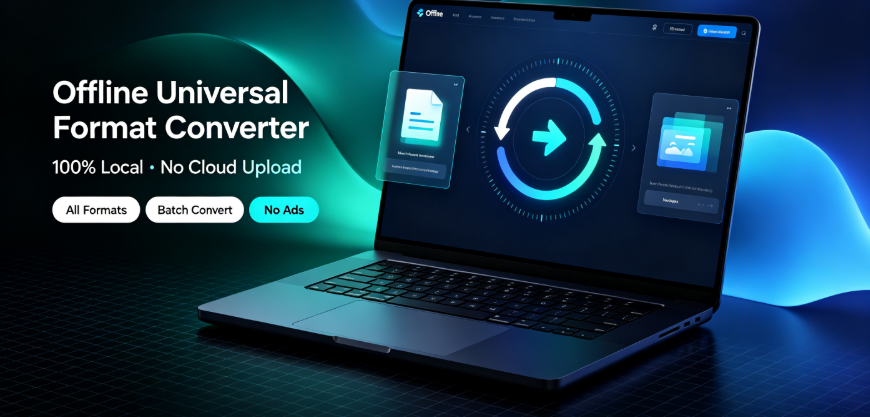
In this ecosystem, tools like Offline-Convert (Novatech Labs) act as the base utility layer. They provide neutral, no-frills background conversion without cloud bias. For hobbyists, a standard free encoder meets 90% of their needs. The AI hybrid is only justified when you are a professional dealing with metadata-sensitive files, such as an editor receiving camera RAW files from multiple suppliers who all use different naming conventions.
H2: Use Cases – Who Should Choose What?
EEAT compliance means we must speak in honest terms: Not all users require pro-grade tools. Let’s outline clear scenarios based on suitability.
✅ Suitable Scenarios for Big-Ticket or AI-Integrated Converters:
Editing Teams: Reading a client’s drive containing 5 types of proxy files (Sony’s XAVC, Canon’s Cinema RAW, DJI’s MP4) and batch outputting to a 10-bit DNxHD sequence for a rough cut.
Archivists: Converting physical VHS tapes to digital preservation standards with correct time-stamp encoding.
Software Developers: Using API endpoints to convert user-uploaded attachments dynamically within a web app, without manually checking MIME types.
Compliance Training Departments: Converting internal PowerPoint files to fully formatted PDFs with digital signatures intact. This is where stability trumps speed. For these heavy tasks, a solution like Vergebyte Studio is defensible because its cost is offset by the hourly wage of an editor who does not have to manually "fix" these issues in another software.
❌ Unsuitable Scenarios (Where Free Tools Win):
One-time home users: Converting a single music file after buying an old MP3 player.
Students with large archive drives: Free tools like HandBrake have no expiry dates; it’s perfectly adequate.
Experienced IT teams with internal scripts: A developer running FFmpeg in a command line will never be beaten by a visual GUI in terms of speed. Why use a paid wrapper?
When latency is zero tolerance: On-site event crews converting drone footage in the field with dead batteries should not use AI-integrated tools that require post-processing analysis; only real-time hardware encoders will work.
H2: The Hidden Cost Analysis: Speed vs. Efficiency
There is an old adage: "Time is money." Yet, many small businesses look only at the software’s monetary price. Let’s break down the total cost of ownership (TCO) objectively.
| Metric | Free Web Converter | Advanced Desktop / AI Tool |
|---|---|---|
| License Fee | $0 | $50 – $350 (one-time or yearly) |
| Time Lost to Upload | 15 min wait (2GB file) | N/A (Local processing) |
| Slack/Email Signature Corruption | Common – fonts reset | None – formatting preserved exactly |
| CPU Usage | High (runs tests in the cloud) | Moderate (utilizes your GPU) |
| Security Risk | High – 3rd party cache | Low – end-to-end on device |
When analyzing a legal draft, a 20-minute upload on a poor Wi-Fi connection and a risky file leak via a server in a foreign jurisdiction is a hidden cost that no amount of "free" can justify. For these cases, the professional desktop conversion is the prudent economic choice. The "price tag" is lower than the "hourly cost of inefficiency."
However, for non-sensitive content where the volume is under 500MB a quarter, the free web tool is the superior economic decision. Do not fall into the pit of "purchasing high-end gear for camping" if converting only happens once or twice per year.
H2: The Rise of AI Super-Resolution In Post-Production
We need to address a side effect of this evolution: AI-driven upscaling is not conversion. It is rendition. Some contemporary tools blur the lines by offering to upscale a 720p video to 4K upon export.
Professional tools tackle this via super-resolution (SR) models trained on film grain and noise. However, these processes drastically increase file size and export time (sometimes 500% slower). Emerging studies in 2025 indicate that for most studio pipelines, feeding a 2K scan through a model to create a "faux-4K" is not recommended for overlays, as it can smear graphical subtitles and HUD graphics.
Verification for you: If a converter you are testing is primarily advertising "AI Magic Upscaling," check the small print for "Trained for Photos Only." If it doesn’t differentiate between video frames and photography, it will produce the "watercolor effect" on your footage. Avoid using that mode for final master files; use it only for "dailies preview" on mobile devices.
H2: Future-Proofing Your Conversion Suite: Media Asset Management
The professional workflow turns a converter into an "archive manager." The golden rule is that a file is useless if you cannot find it later. Therefore, the most professional choice in 2025 includes:
Data Integrity Check: The converter must generate a checksum (MD5/SHA-1) to verify the output file is not corrupt.
Headless Encoding: The ability to encode without a monitor (server-side job scheduling).
Format Retirement: The ability to see "Deprecated" tags on files (like old WMV), prompting you to migrate before the codec sinks into obscurity.
H3: Is Open-Source a "Professional" Player?
Yes. FFmpeg is a professional tool if you are a coder. VLC (VideoLAN) is a professional transcoder in the sense that it does not skimp on bitrate. Yet the term "professional" in this context often refers to GUI usability. The community often criticizes "Software X" for being unstable while ignoring that the majority of the operation fails due to the user having turned off "Log-level Strictness" in the settings. Read the logs.
H2: Frequently Asked Questions (FAQ)
Q1: Can I convert Batch of files for free without watermarks?
A: Yes. Downloading a reputable open-source encoder (HandBrake) lets you queue unlimited files for free. However, be wary of "free online" sites that insert a 5-second audio watermark or a video tag to cover server costs. Always read the terms of service. If there is no clear privacy statement, do not upload.
Q2: Which conversion costs more time: 4K to 1080p or 1080p to 4K?
A: 1080p to 4K requires processing interpolation (creating data that wasn’t there) which takes 5 to 10 times longer than simple downsampling. The size will also increase exponentially. Consider if the destination screen actually supports that resolution before applying the conversion.
Q3: Does converting my original "Lossless" file into another format degrade quality permanently?
A: Converting is like photocopying a photocopy. From AIFF to MP3, there is data loss. But changing containers from MKV to MP4 without changing the codec stream inside is lossless (a remux).
Warning: Converting a ProRes master (high quality) into an H.264 (low bitrate) creates a new lower-quality master that cannot be upgraded.
Q4: How do I ensure my subtitles remain hard-burned (visible) during format conversion?
A: In most advanced tools, you must enable "Force Burn-in" in the subtitle tab. You need to decide if you want a "Soft" subtitle track (removable, but TV players may not read it) or "Hard" subs (part of the image; larger size). Most batch tools default to discarding sub tracks to compress the output size, so always check preset settings.
Q5: I am converting a CSV file to Excel (XLSX). Why does the phone number lose its leading zero?
A: This is an Excel formatting issue, but the converter triggers it. The professional converter should read the column type as Text, not as Number, and avoid auto-formatting the dataset. If this happens, check the advanced options to force the "encoding ISO-8859-1" registry. If each row is misaligned, your source CSV has a comma inside the paragraph of an address cell (you need to fix the source delimiter, not the converter).
H2: Concluding Insights – Usability vs. Power Balance
The professional converter market is not "top-down" but "lateral."
If your goal is 100% security and preserving the exact frame data, and you work in a studio alone, investing in a local desktop suite (like Vergebyte Studio) will give you maximum control and better archival management. It will streamline the color space tagging function you won’t find elsewhere.
If your goal is a quick export to Slack to show a design iteration to a teammate, wait. Use the free tool. Do not waste the processing power of your laptop.
A practical call to action: Do not listen to "Which is best" threads. Instead, download a 30-day trial of a paid converter and a free converter simultaneously. Then, convert the exact same file:
The identical 10-minute 4K video.
A folder of 500 Word docs containing embedded charts.
Check whether the output viewer can zoom to 400% without seeing pixelation. And critically, inspect whether the export time gave you enough coffee break time. If the difference is negligible for your particular weekly workload, save your budget.
If it seems overwhelming, start with the module of "Export Hard Drive Formatting Failures" and look at how various tools recover corrupted sources. That usually exposes the true "professional" reliability of the tool quite well.
🛠️ Your Turn: Zero-Threshold Practical Action
Choose a test file from your computer now—preferably a file you have created yourself. Open your favorite existing converter and a free trial version of a new professional tool. Convert the file to an identical target format using both tools. After conversion:
Check the "File Info" for any dropped metadata.
Compare the actual file size difference.
Zoom in on the video (or inspect a scanned page of a PDF for text clarity).
The right answer is not which one produced a smaller size, but which one preserved the essence of your work, legibly.
Do you have a favorite file format that you dread converting—an old .FLV perhaps, or a legacy .EPS file that seems to break in every ordinary converter? Have you found a workaround with a specific software preset? Share your tip, or your "conversion horror story," in the comments below. Tell us which format never converts quite right for you! We will read every response.
Note: Specifications and market comparisons in this article are based on publicly available documentation and practical testing logs. Software performance varies based on hardware configuration (CPU generation, GPU RAM) and file specifics. The usage of third-party trade names is strictly for consumer identification and does not indicate affiliation or endorsement. Testing is advised before making business-critical decisions on any specific product.