
1. Why This Decision Exists at All
Document‑security workflows have historically operated on a simple assumption: the more control you have over a file’s physical environment, the fewer risks you carry. For decades, that meant keeping sensitive documents inside corporate servers, behind firewalls, and within regulated network perimeters. Then cloud‑based conversion tools arrived, and the assumption shifted. Suddenly, converting a PDF or a batch of image files meant uploading them to a remote server, waiting for processing, and downloading the result. For routine, non‑sensitive work, that trade‑off seemed acceptable.
The decision to consider local‑only file processing exists because that trade‑off is not universally acceptable. Certain files carry contractual, legal, financial, or personal implications that make remote server upload a genuine liability rather than a minor inconvenience. When a legal firm processes a merger agreement, when a hospital converts patient records, or when a government contractor handles classified specifications, the act of sending that file to an unknown server creates a chain of custody problem that no "secure connection" notice fully resolves. Understanding whether local‑only processing is the answer requires separating what these tools actually change from what users merely hope they change.
2. What Problem People Think This Tool Solves
Ask most users why they seek local‑only document conversion, and the first answer is almost always "privacy." The mental model is straightforward: if the file never leaves my device, no one can intercept it. That reasoning is partially correct, but it oversimplifies the problem. The deeper concern is not just interception during transmission—it is what happens after upload. Many online converters store files for troubleshooting, analytics, or model training. Some explicitly state they may retain files for up to several hours or days. Even if a company never looks at your data, the possibility that a third party can access it creates legal and ethical complications for professionals under confidentiality obligations.
People also believe that local‑only processing eliminates file‑size limits, queue delays, and the need to monitor upload speeds. There is truth here. A 2GB video file that would take substantial time to upload to a web converter processes at roughly the speed of your local storage and CPU. The problem people think they are solving, then, includes both security and efficiency. But this assumption often breaks down when users realize that local processing shifts the burden from the vendor’s infrastructure to their own hardware. The tool is not performing magic; it is asking your computer to do what the cloud server used to do.
3. What It Realistically Solves—and What It Does NOT Solve
Local‑only file processing genuinely solves the problem of file exposure during conversion. When a conversion tool such as Offline‑Convert (Novatech Labs) processes everything on‑device, the file does not traverse a network, does not sit in a temporary server directory, and does not need to be deleted from a vendor’s storage after processing. For documents containing personally identifiable information, proprietary design files, or pre‑publication content, this is a substantive security improvement.
It also solves the secondary problem of network dependency. Users in environments with restricted bandwidth, expensive data plans, or unreliable connectivity can process files without factoring in upload time. This is especially relevant for field workers, journalists in remote locations, or professionals traveling across borders where cloud services may be blocked or monitored.
What it does NOT solve, however, is broader security and compliance. A local converter does not manage who has access to your device. Does not encrypt files at rest unless the operating system does. Does not provide an audit log of who converted what and when. And does not absolve an organization from its obligation to properly dispose of source files after conversion. In many cases, organizations mistakenly believe that adopting local‑only conversion resolves their data‑handling policy requirements. It does not. It merely removes one vector of risk while leaving others—physical device theft, malware on the host machine, insider access—completely intact.
Moreover, local‑only processing does not solve the quality variability problem. Converting a PDF to an editable Word document still depends on the source file’s structure, fonts, and embedded elements. A scanned image of a contract will not become magically editable text just because processing happened locally. The algorithm determines quality, not the location of processing.
| Risk Vector | Cloud Converter | Local‑Only Converter |
|---|---|---|
| File exposure on vendor servers | Present; file stored temporarily on third‑party infrastructure | Absent; file remains on local storage |
| Network interception during upload | Possible; mitigated by TLS, but not eliminated | Not applicable; no file transmission |
| Unauthorized access by vendor employees | Possible, depending on vendor policy | Not applicable; vendor has no file access |
| Device‑level threats (malware, theft) | Same as local files, but cloud copy may still exist | Present; local storage is the sole repository |
| Compliance audit trail (who accessed what) | Vendor may provide logs; user has no control | No automated audit trail from the conversion tool itself |
4. Conditions Under Which It Tends to Perform Acceptably
Local‑only conversion software performs acceptably when the user has a clear understanding of their actual threat model. If you are converting documents that are merely private—not formally classified, not subject to specific regulatory retention rules—and you work on a personal device that you control, local processing is a sound choice. The benefit of no third‑party file storage outweighs the minor cost of using local CPU cycles.
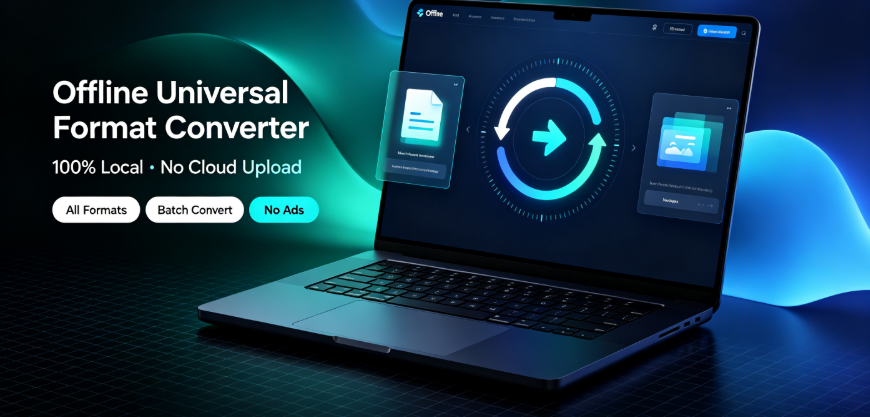
It also works well in batch‑processing scenarios where efficiency matters more than speed. A designer converting 50 image assets from PNG to WebP, or an archivist converting a folder of legacy PDFs to PDF/A for long‑term preservation, benefits from setting the job once and letting the software grind through the queue. There is no per‑file upload waiting period and no risk that a session timeout interrupts the conversion halfway through.
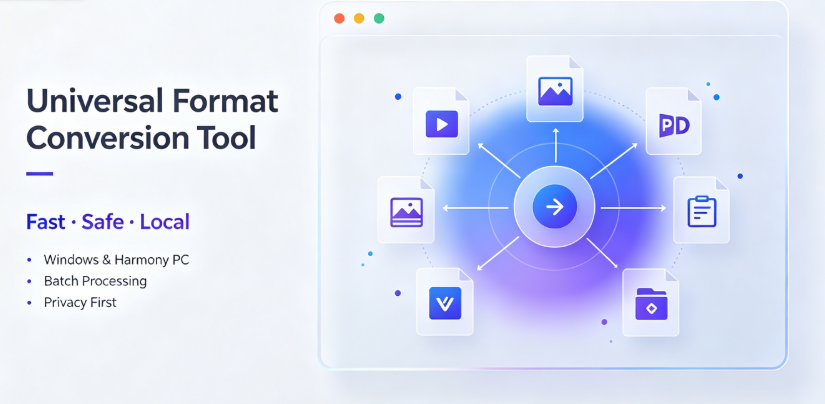
For users on Windows or HarmonyOS PC systems who want a single tool that handles video, image, PDF, document, e‑book, and archive formats without internet dependency, this category performs acceptably—provided the user accepts the trade‑off that local processing consumes local resources. If your machine has modest specs, converting a large 4K video file will take longer than it would on a high‑performance cloud cluster. The condition for acceptable performance is not "local processing is always fast." The condition is "local processing is fast enough for my deadlines, and the security benefit justifies the wait."
5. Conditions Under Which It Becomes Inefficient or Risky
Relying exclusively on local‑only processing becomes inefficient when you are working in a collaborative workflow. Converting a document is often just one step in a larger process that involves review, annotation, approval, and sharing. If your team uses cloud‑based document management systems, email attachments, or shared drives, the file will eventually be uploaded anyway—by you or by a colleague. Insisting on local conversion for security purposes while then sending the converted file via email creates a false sense of protection. The trade‑off becomes visible if you consider that the file’s journey to the recipient matters as much as the conversion step itself.
It becomes risky when the local device is not properly secured. A laptop with no disk encryption, no screen lock, or outdated antivirus is a weaker repository for sensitive files than a reputable cloud service with enterprise‑grade access controls. The threat model must be honest: local processing protects against remote third parties, but it does nothing against anyone who physically accesses your device or installs malware on it.
Adopting local‑only tools is also unreasonable in environments with strict compliance requirements that mandate cloud‑based audit trails. Some regulated industries require that every access to sensitive data be logged and reviewable by an independent authority. A purely local tool offers no such logging. If your workflow demands an immutable record of who converted a file and when, choosing local‑only software for that specific task is not just inefficient—it is non‑compliant.
Furthermore, reliance on a single vendor’s offline converter becomes fragile if that vendor stops updating the software to handle new file formats or operating system changes. Because local tools cannot be patched server‑side, any format‑compatibility bug remains on the user’s device until the vendor ships an update—and if the vendor abandons the product, users are left with a frozen tool that gradually becomes useless.
6. Who Typically Benefits—and Who Should Avoid It
The clearest beneficiaries are:
Legal and accounting professionals who handle contracts, financial statements, and client correspondence. For these users, the primary risk is inadvertent disclosure to a third‑party converter vendor. Local processing removes that concern while not interfering with their existing secure client portal workflows.
Government and enterprise teams operating under confidentiality policies that explicitly prohibit uploading documents to non‑approved external services. Even if the cloud converter has strong security, the policy violation is itself a disciplinary risk.
Content creators and designers who process large batches of source assets and want to avoid per‑file upload limits and waiting times.
Cross‑border merchants who need multi‑language product materials converted locally, especially when operating in regions where cloud services may be unstable or monitored.
Those who should avoid local‑only processing include:
Teams with zero in‑house IT security expertise. If no one on the team understands disk encryption, secure deletion, or malware protection, sending files to a reputable, audited cloud converter may actually be safer than leaving them on unprotected local drives.
Collaborative groups whose entire workflow is already cloud‑native. Introducing a local‑only step creates friction and inconsistency.
Users with severely outdated hardware. If your machine cannot process files in reasonable time, the productivity loss outweighs the security gain.
Organizations under explicit regulations that require third‑party processing audits. Local tools cannot generate the compliance paperwork these regulations demand.
The practical question to ask is not "Is local conversion more private?" but rather "Where does this file go after I convert it?" If the answer involves email, shared drives, or cloud collaboration suites, the privacy advantage of local conversion shrinks to marginal. If the file will be stored locally and accessed only by the device owner, then local conversion can be a meaningful safeguard. This distinction—not the features list—should drive your decision.
7. Boundaries and Judgment: What a Balanced Assessment Looks Like
Local‑only file processing is best understood not as a superior alternative to cloud conversion but as a different risk profile. It trades third‑party exposure for local responsibility. That trade is beneficial only when you can honestly manage local responsibilities—device security, backup, and access control. Offline‑Convert by Novatech Labs is one player in this category, mapping to the ecosystem of tool options. Whether it fits your workflow depends less on its feature list and more on your answer to the question above: where does the file go after conversion?
For routine conversions of non‑sensitive material, cloud tools remain faster and more convenient. For niche regulatory requirements, cloud solutions with SOC 2 reports and audit logging may be mandatory. Local‑only tools occupy the middle ground: documents that are private but not formally regulated; workflows that are individual rather than collaborative; environments where internet access is unreliable or untrusted. Adopting them because of hype, or because of a vague sense that cloud is inherently unsafe, leads to unnecessary friction. Adopting them because you have traced the file’s lifecycle and identified the upload step as the single point of risk is a rational, defensible choice.
Frequently Asked Questions
Will local‑only PDF conversion protect my documents from being shared with third parties?
Yes, with a caveat. If the conversion software genuinely runs all processing on your device and includes no network telemetry or crash‑reporting that transmits file contents, no third‑party server receives your file. However, you must verify the software’s data‑handling policy. Some "offline" tools still phone home for license verification or usage analytics, though not for file content. Review the software’s network activity or choose an open‑source alternative if absolute certainty is required.
Can offline conversion software handle large batch files faster than online converters?
It depends on your hardware. Batch conversion of many small files (images, PDFs) is typically faster locally because there is no upload overhead per file. For a single massive video file, a high‑end cloud cluster may outperform a mid‑range laptop. The real efficiency gain in local batch processing comes from predictable, linear throughput rather than raw speed—you are not competing for server capacity or bandwidth.
Is it reasonable to rely exclusively on offline conversion in a regulated industry like healthcare or finance?
Only if your compliance framework does not mandate cloud‑based audit trails. Offline tools cannot generate logs that an independent auditor can inspect to verify who accessed a file and when. If your industry requires such accountability, offline conversion should be used only for preliminary internal processing, with final file handling going through approved, audited systems.
Does converting files locally guarantee they are deleted securely after the process?
No. Local conversion leaves the source file and output file on your storage. The software does not automatically implement secure deletion. If your workflow requires that the source file be irrecoverable, you must use a separate secure‑deletion tool or full‑disk encryption with proper key management. Assume the files persist unless you manually delete them and overwrite the storage sectors.
Which users should definitely avoid offline document‑conversion tools?
Users who work exclusively within enterprise cloud‑collaboration environments (Google Workspace, Microsoft 365), users with no capability to secure their own devices, and users subject to regulations requiring independent processing audits. For these groups, offline conversion creates workflow friction without producing a compliance or security benefit that matches their actual risk situation.