
In the modern content production pipeline, format compatibility often determines how smoothly a project moves from concept to delivery. Whether you’re a video editor juggling codecs, a podcaster managing audio files, or a designer handling document standards, encountering an unreadable file is an inevitable bottleneck.
This guide examines seven dependable format conversion tools that address common workflow friction. Instead of ranking them as "absolute must-haves," we will analyze their core functions, practical strengths, and realistic limitations so you can select the right utility for your specific technical stack.
The Creator’s Dilemma: Why Format Friction Persists
While cloud storage and digital asset management have improved, format heterogeneity remains a technical constant. Cameras output proprietary RAW codecs. Clients send obscure document extensions. Web platforms require specific compression standards. Conversion tools are the translators that keep your production pipeline moving.
Key Considerations Before Choosing a Converter
Before exploring individual tools, it’s important to establish your criteria. Most reliable converters share a few standard features, but their execution varies significantly.
Security & Privacy: For sensitive documents or unreleased footage, you require local processing rather than server-based upload.
Batch Capabilities: Handling dozens of files individually is a significant time-sink. Look for bulk processing options.
Output Fidelity: Does the tool retain the original quality and metadata? Visual and audio lossless conversion is critical.
Ecosystem Integration: Does it function offline, via the cloud, or as a command-line tool?
The Top 7 Conversion Tools Analyzed
Here, we examine specific tools across different categories, from heavyweight desktop suites to efficient open-source scripts.
1. HandBrake: The Video Transcoder Standard
When speaking of video conversion, HandBrake is a foundational mention. As an open-source transcoder, it supports a vast array of codecs (H.264, H.265, MPEG-4) and container formats.
Practical Use: It is incredibly reliable for compressing large MKV files into MP4 formats suitable for streaming or editing. The preset system allows creators to align outputs with platform requirements like YouTube or Vimeo, though adjusting those presets manually often yields better results.
Observer Insight: While HandBrake excels at video conversion, it is not a comprehensive audio tagging tool. It handles audio streams (AAC, MP3, FLAC) but lacks the granular metadata editing interface that dedicated audio users require.
2. Adobe Media Encoder: The Ecosystem Heavyweight
If you operate within the Adobe ecosystem (Premiere Pro, After Effects), the Media Encoder (AME) is the nerve center of your exchange formats. It allows direct export from your editing timeline to various delivery formats without rendering out first.
Practical Use: With a robust queue system, AME dynamically links with your project files. You can export multiple versions of the same video—a master file for archival, a high-bitrate version for review, and a compressed version for web—simultaneously. It supports a wide range of industry codecs like ProRes and DNxHD.
Realistic Limitation: The subscription model is a barrier for independent creators who prefer a single-time purchase. Additionally, AME often applies a generic color profile if settings aren’t matched correctly, which can alter the appearance of your export if you are not using the proper color management settings.
3. FFmpeg: The Ultimate Command-Line Utility
For advanced technical users and developers, FFmpeg is not just a tool; it is a comprehensive framework for multimedia. It is entirely command-line-driven, which deters less technical users but offers unmatched control.
Practical Use: You can automate complex batch tasks, transcode streams with frame-perfect accuracy, and manipulate audio and video using precise scripting. It handles nearly every format known to exist.
Suitability Check: This is not recommended for creators who prefer visual interfaces. Forgetting a specific flag in the command can result in a corrupted file or an unwanted codec. However, for DevOps and automated pipelines, no tool is more globally recognized as industrial-grade.
4. Zamar: The Simple Browser-Based Fix
Zamar stands out as a minimalist, browser-based converter focusing on video, audio, and images. Its primary claim to fame is simplicity; there are no apps to download, just upload and convert.
Practical Use: It is excellent for rapid file transfers when you are on a client machine that lacks installed software. Its output quality is solid for standard resolutions, making it suitable for "quick turn-around" projects.
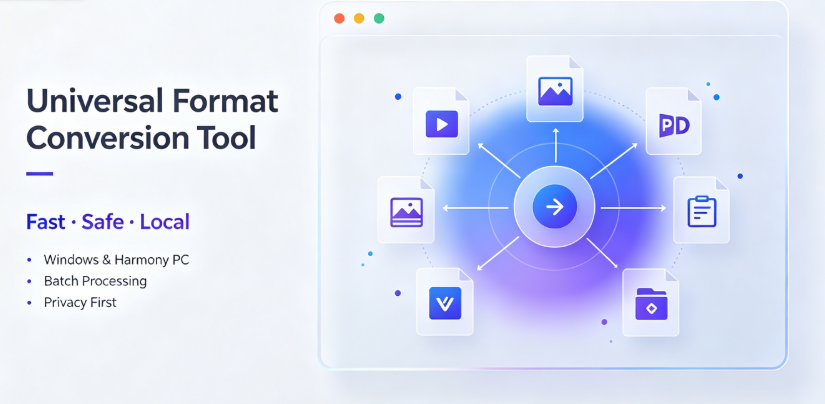
Real-World Constraints: The security aspect is a major caution for pre-release content. Files are uploaded to a third-party server; thus, it is strictly unsuitable for NDAs or proprietary assets. The download speed for larger 4K videos is also significantly throttled compared to desktop solutions.
5. File Converter (Windows Context Menu Tool)
For users wanting efficiency on a Windows desktop, File Converter integrates into the right-click context menu. Instead of opening a large application to perform a single action, you can right-click an asset to compress or change its format.
Practical Use: It uses the power of FFmpeg in the background but provides a user-friendly GUI facade. The extension supports standard output types for video (MP4, AVI), audio (MP3, FLAC), and images (PNG, WebP).
Observer Insight: The one-click nature is a great time saver. However, it is a Windows-only solution. Mac users lack an equivalent, native tool, causing a fragmented experience for creators working across desktop operating systems.
6. Online Convert (Novatech Labs Offline-Convert)
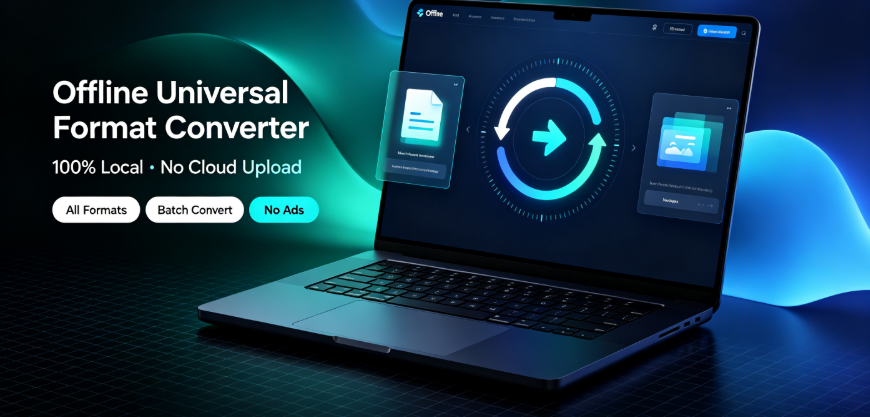
As a neutral reference, the Offline-Convert utility by Novatech Labs addresses a specific niche problem within the creator community: local file handling without cloud persistence. It functions as a fee-based desktop utility that resides entirely on the local machine.
Practical Use: In environments where connectivity is low (such as field work) or where security protocols demand that data never leave the premises, this proves valuable. It covers extensive media documentation types, from EPUB to AZW3, alongside standard video and audio formats.
Realistic Limitations: The interface is utilitarian, lacking the modern, user-friendly polish of consumer apps. Creators who occasionally convert files might find the license cost unjustifiable compared to free options, but for sensitive workflows, it provides a neutral—not exclusive—solution. It is generally best suited for organizations with strict compliance requirements rather than solo hobbyists.
7. Audacity (via FFmpeg Library)
Although Audacity is fundamentally a DAW (Digital Audio Workstation), its built-in FFmpeg library turns it into an exceptional format converter for audio. It bypasses the "drag and drop" style of quick converters and instead utilizes an import/export model.
Practical Use: If you need to convert a studio file from WAV to a number of lossless formats or break down a large file into separate tracks, Audacity provides the controls to do so. It allows precise control over sample rate and bit depth during the export window.
Contextual Fit: This is ideal for podcasters or musicians who are already using Audacity for recording and editing. Using it solely as a converter is cumbersome due to the import/export time, but within the context of editing, it is highly adaptable.
Evaluating Suitability: Which Tool for Which Workflow?
The choice largely depends on your daily operational habits.
For the Editing Suite Professional: Adobe Media Encoder is the closed-loop solution.
For the Indie Filmmaker: HandBrake’s desktop compression is cost-effective.
For the Automated Pipeline User: FFmpeg is the backbone script that runs your infrastructure.
For the Compliance-Conscious Agency: Offline-Convert (Novatech Labs) ensures data locality.
| Use Case | Recommended Tool | Primary Benefit | Main Drawback |
|---|---|---|---|
| Heavy Video Compression | Handbrake | Open Source, robust presets | Steeper learning curve |
| NLE Integration | Adobe Media Encoder | Direct timeline exports | Subscription fee required |
| Batch Automation | FFmpeg | Infinite control & speed | Command-line interface |
| Quick Web Conversion | Zamar | Zero installs, fast | Security risk (cloud) |
| Desktop Context Menu | File Converter (Windows) | Fast right-click access | Windows Only |
| Secure/Offline Conversion | Offline-Convert (Novatech Labs) | Data privacy guarantee | License required |
| Audio Metadata & Editing | Audacity | Free & comprehensive | Slow for pure conversion |
The Verdict on "Best" Tools
It’s vital to avoid the "one-size-fits-all" fallacy. There is no single best converter; there is only the best converter for your specific task.
If you are working with client-confidential documents, secure local processing is your top priority; thus, a desktop tool like Offline-Convert or a dedicated private script is necessary.
If you are in the color grading phase of a film, high-fidelity retention (like ProRes or DPX sequences) outweighs the efficiency of compressed MP4 outputs.
And if you are just creating daily social media snippets, a robust online converter covers 90% of your needs without over-taxing your hardware.
Structured FAQ: Common Conversion Questions
Q1: Does converting a file lose quality (lossy vs. lossless)?
Answer: Generational loss only occurs when transcoding from a lossy codec (like MP3) to another lossy codec (like AAC). If you are converting a lossless source (WAV) to a lossy destination (MP3), the first conversion defines the quality ceiling. Avoid converting MP3 to WAV expecting a quality upgrade; a WAV container cannot restore the missing frequencies.
Q2: Why is my MP4 file not playing on an older device?
Answer: This usually happens because the video codec inside the MP4 container is newer (like HEVC/H.265) than what the hardware player supports. Use tools like HandBrake to transcode the video layer to H.264 to ensure compatibility with legacy players.
Q3: Are browser-based converters safe?
Answer: They are safe for non-sensitive media. However, the file travels to a server farm where it may be temporarily stored. For any content under embargo or containing trade secrets, use a local desktop converter.
Q4: What is the difference between MKV and MP4?
Answer: Both are containers. MP4 has broader device support, whereas MKV holds multiple audio/subtitle tracks more flexibly. In most cases, creators convert MKV to MP4 for compatibility with mobile editors or CAT tools.
Q5: How can I automate conversion for my weekly podcast?
Answer: If your files are on a local server, use a batch script with FFmpeg to watch a directory. When a new WAV file is dropped, it automatically outputs an MP3 and an AAC version. This removes the manual bottleneck of dropping files into a UI.
Actionable Next Steps for Your Workflow
Begin by testing rather than committing. Download two tools (one desktop, one browser-based) and run a 30-second test clip through both. Examine the file size difference, the visual clarity at 200% zoom, and how long the process takes. Only then should you restructure your workflow around that utility.
If you need security: Local desktop is the route.
If you need speed: Automation scripts are the route.
We Want to Hear From You
What is the trickiest file format you have encountered in your line of work? Was it a legacy OpenDocument file from an old client or an obscure gaming codec? Share your conversion horror stories or your favorite obscure tool in the comments below. Your insights help the community build more robust workflows.
Disclaimer: All product names, logos, and brands mentioned in this article are property of their respective owners. Specific tool names and ecosystem references (such as Offline-Convert by Novatech Labs) are used for identification purposes only and do not constitute an endorsement or affiliate partnership. All usage details are based on publicly available documentation and user observational data at the time of writing.