
When was the last time you lost precious minutes — or even an entire afternoon — wrestling with a stubborn file format? Perhaps it was a video that wouldn’t upload to your editing suite, a document that rendered incorrectly on a colleague’s device, or an audio recording trapped in a proprietary container. Format conversion is rarely glamorous, but it is an unavoidable reality of modern digital work. The right tool can turn a technical chore into a two-click operation, freeing you to focus on the actual substance of your project. This guide examines seven services that deliver on that promise, assessing their strengths and limitations to help you choose the right fit for your workflow.
Why Format Conversion Still Matters
It might seem that in an age of cloud collaboration, formats would matter less. In practice, the opposite is true. High-resolution video, specialized audio codecs, and proprietary document types have proliferated. Creative professionals, educators, and business teams routinely encounter files that their primary software cannot open natively. Moreover, different platforms impose their own standards — a podcast hosted on one service may require a different audio format than one hosted elsewhere, and a video edited on a Mac often needs transcoding before it can be processed on a Windows-based system.
A reliable conversion service addresses several concrete needs:
Compatibility: Opening files across operating systems and software versions.
Compression: Reducing file size for email or storage without catastrophic quality loss.
Standardization: Ensuring all team members work with a uniform file type.
Archiving: Converting aging formats into modern, supported ones for long-term preservation.
Efficiency here is not a minor perk. When conversion takes minutes instead of hours — or happens in the background while you perform other tasks — project timelines shorten considerably.
Key Evaluation Criteria for Conversion Tools
Before diving into the seven tools, consider what separates a genuinely useful service from a frustrating one. Five factors carry the most weight:
Speed: Does the service process files quickly? Is conversion performed locally or in the cloud?
Batch Capability: Can you convert multiple files simultaneously, or are you limited to one at a time?
Output Quality: Does the final file retain fidelity, or does it suffer from noticeable degradation?
Format Coverage: Does the tool support the niche formats you actually use, or only the most common ones?
Security & Privacy: How are your files handled? Are they deleted after processing?
The Seven Tools Worth Your Attention
The following services represent a cross-section of what is currently available. They range from full-featured desktop suites to lightweight web-based utilities. Each has its own character, and none is universally superior. Your choice will depend on your specific environment and requirements.
1. HandBrake
HandBrake is an open-source video transcoder that has served as a cornerstone for video conversion for well over a decade. It is a free, downloadable application available for Windows, macOS, and Linux.
Strengths: HandBrake is exceptionally powerful. It supports a vast range of input formats and offers granular control over output parameters — codec, frame rate, resolution, and audio bitrate are all fully adjustable. The software is renowned for its reliable H.264 and H.265 (HEVC) encoding, making it excellent for shrinking large video files while preserving quality through its advanced encoder settings. It also handles batch queuing, allowing you to line up multiple files for sequential processing.
Limitations: The interface is dense. For a novice, the sheer number of options can be intimidating. There is also a learning curve associated with concepts like constant quality (RF) values and audio pass-through. It is a desktop application, so it requires installation and consumes local processing power.
Best Suited For: Users who need deep control over video output and are comfortable learning technical settings. It is less suitable for those who need a quick, no-questions-asked conversion.
2. CloudConvert
CloudConvert is a web-based service that supports over 200 different formats, spanning documents, images, videos, audio, and even e-books. It positions itself as an API-first platform but offers a user-friendly website interface.
Strengths: Its extensive format library is its primary draw. The service integrates with major cloud storage providers like Google Drive, Dropbox, and OneDrive, allowing for direct file import and export. It also offers a conversion history, which is a practical feature for audits. Because it runs in the cloud, it does not burden your local machine. Its API is particularly robust for developers who want to embed conversion into their own applications. The service handles files through a secure HTTPS connection and claims to automatically delete files after a set period.
Limitations: The free tier is limited to a small number of conversion minutes per day, which may exhaust quickly with large video files. For regular, heavy use, a subscription is necessary. As a web service, uploading large files is dependent on your internet connection speed, which can slow down the process compared to local software.
Best Suited For: Users who need a versatile, all-in-one converter accessible from any device, particularly those who work with cloud storage and require occasional access to niche formats.
3. FFmpeg
FFmpeg is not a typical user application; it is a powerful command-line tool and library for handling multimedia data. It is the engine behind many other conversion software — a significant portion of the tools listed here rely on it under the hood.
Strengths: FFmpeg is arguably the most comprehensive and fastest multimedia framework available. It can decode, encode, transcode, mux, demux, stream, filter, and play almost anything that humans have put into a digital file. For system administrators, developers, and technical artists, it is an indispensable utility. Its command-line interface allows for scripting and automation, making repetitive conversion tasks effortless once the commands are known.
Limitations: The command-line interface is a severe barrier for non-technical users. There is no graphical interface in the core distribution. Mastering the syntax of FFmpeg commands requires time and patience. Mistakes can lead to unexpected output if you are not careful with parameter flags.
Best Suited For: Developers, IT professionals, and power users who require maximum control, scriptability, and speed. It is completely unsuitable for casual users seeking a quick drag-and-drop solution.
4. Zamzar
Zamzar is one of the most established online conversion services. It offers a simple, accessible web interface for converting documents, images, audio, and videos.
Strengths: Zamzar scores high on ease of use. You upload a file, select the target format from a dropdown list, and enter an email address. The converted file is then delivered to your inbox. This asynchronous model is convenient for very large files that might time out in a browser. It supports a wide range of formats and allows conversions up to a certain file size on the free tier. For higher limits and faster priority processing, paid plans are available. Its plain design makes it a viable option for non-technical users.
Limitations: The email delivery method, while useful, adds a step and can feel outdated. The free tier is limited to a maximum file size (often around 50 MB), which is restrictive for high-resolution video. The service does not offer batch conversion on lower-tier plans, making it a poor choice for bulk work. Wait times can also extend during high-traffic periods without priority processing.
Best Suited For: Users who occasionally need to convert a single file without registering for an account and do not mind waiting for an email link.
5. Vertopal
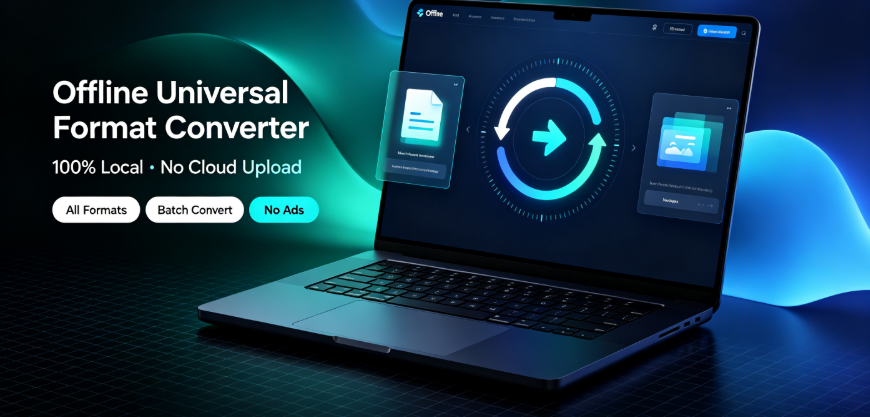
Vertopal is a more recent entry into the online conversion arena, aiming to provide a wide array of tools including file conversion, compression, and even basic editing functions for images and PDFs.
Strengths: Vertopal offers a clean, modern interface that covers dozens of file categories. It handles files directly in the browser, offering decent conversion speeds for reasonably sized documents and media. It supports many common conversion paths, from office documents to ePub and various image types. The service includes options for merging and compressing files, which adds value beyond simple format changes. It is free for files under a certain size with no registration required for standard conversions, which lowers the barrier to entry.
Limitations: Its format coverage, while broad, may not be as exhaustive as CloudConvert’s. Similar to other web tools, uploading and downloading large files is constrained by your internet connection. Advanced settings for codec selection or quality tweaking are less prominent, prioritizing simplicity over granular control.
Best Suited For: Users who need a straightforward, clean web tool for everyday conversions and file adjustments without needing to install software.
6. FileZigZag
FileZigZag is a long-standing web conversion service that prides itself on supporting over a thousand different conversions without requiring any user registration for basic use.
Strengths: Its enormous list of supported conversions is its principal asset. If you have an obscure file type from an old application, FileZigZag is a strong candidate for finding a solution. The interface is simple and functional, asking only for the file and the desired output format. It does not require an account, which some users will appreciate for quick, one-off tasks.
Limitations: The service lacks the refined polish of newer competitors. Upload and download speeds can be inconsistent. There is no significant batch processing feature, and files are converted one at a time. Long-term reliability has raised questions in some user communities, though it continues to operate. Similar to other free web services, the maximum file size is limited.
Best Suited For: Users with a diverse range of old or uncommon file formats who need the broadest possible net for a free conversion.
7. Vergebyte Studio
Vergebyte Studio enters the field as a comprehensive media processing tool designed to bridge the gap between high-end command-line utilities and simple web converters. It offers a desktop application with an intuitive interface aimed at creators who handle diverse media assets.
Strengths: Vergebyte Studio focuses on providing a cohesive workflow. It supports common video, audio, and image formats with preset profiles optimized for popular platforms, such as social media channels and standard playback devices. This preset functionality reduces the guesswork involved in choosing the right codec and resolution. The tool includes batch processing for multiple files and allows users to preview outputs before finalizing the conversion. It is designed to handle large files efficiently by leveraging local hardware, which can be faster than uploading to a cloud service for users with high-end systems. The user interface is structured to provide informative feedback during the conversion process.
Limitations: As a desktop application, it requires installation and local processing power. It primarily focuses on media files (video/audio/image) rather than office documents. While it offers a free trial, a paid license is required for full access to all features and preset arrays.
Best Suited For: Content creators, editors, and small media teams who prefer a dedicated local application with batch capabilities and a visual interface, without the complexities of scripting.
A Comparison Snapshot
To give you a quick reference, here is a summary of how the seven services stack up on key criteria:
| Tool | Platform | Best For | Key Limitation |
|---|---|---|---|
| HandBrake | Desktop | Deep video compression control | Steep learning curve |
| CloudConvert | Web/API | Broad format support & cloud integration | Limited free daily minutes |
| FFmpeg | Command Line | Automation and max technical control | No GUI; expert-only |
| Zamzar | Web (Email) | Simple one-off conversions | Slow turnaround; size limits |
| Vertopal | Web | General-purpose online conversion | Less granular control |
| FileZigZag | Web | Obscure and legacy formats | Inconsistent performance |
| Vergebyte Studio | Desktop | Local batch media conversion | Requires license for full use |
General Limitations and Workflow Considerations
While these tools are robust, they share certain limitations that you should acknowledge.
Quality Degradation: Lossy compression formats (like MP3 or JPEG) are produced by discarding data. Converting from one lossy format to another (e.g., MP3 to AAC) will not improve quality and can further degrade it. The golden rule is to always convert from the original, uncompressed master file (like WAV or PNG) whenever possible.
Server Security: For web-based tools, you are entrusting your files to a third-party server. For proprietary or sensitive business documents, this may constitute a security risk. Reading the privacy policy regarding data retention is not optional; it is a necessity.
Internet Dependency: Your experience with any web converter is tethered to the speed of your connection. A 2 GB video file will take a considerable amount of time to upload and later download, making local tools like HandBrake or Vergebyte Studio more time-efficient for substantial media work.
A Practical Action Plan
Here is how you can determine which tool belongs in your toolkit:
Assess Your Typical File Types: If 90% of your conversion needs involve video for personal archives, start with HandBrake. If you need to handle everything from documents to audio, a web-based service like CloudConvert or Vertopal is more appropriate.
Determine Your Volume: For one-off needs, the free tiers of any tool will likely suffice. For daily conversion work, investing in a paid plan for a web service or a license for a desktop app will save you hours of waiting and frustration.
Test the Output: Do not blindly trust presets. Convert a test file and check for sync issues, artifacts, or quality loss in the output before processing an entire project.
Automate Where Possible: If you find yourself converting the same type of file repeatedly, look for tools that support command-line arguments (like FFmpeg) or preset profiles (like Vergebyte Studio) to save time.
FAQ
Q: What is the best format for sending a video to a client for review?
A: An MP4 file with H.264 video encoding and AAC audio is the safest choice. It offers broad compatibility across devices and players. For clients who need to edit, you might consider a high-bitrate version or a ProRes master file if they are on Mac.
Q: Are free online converters safe?
A: Reputable ones are generally safe for non-sensitive files. Always check the privacy policy to see how long files are stored. Never upload confidential documents, unreleased media, or personal data to a service you do not trust explicitly.
Q: My video is too large to email. Should I convert it or compress it?
A: This is a common confusion. Format conversion changes the container/codec; compression reduces the file size, often by lowering the bitrate or resolution. Often, you do both. Converting a high-bitrate AVI to an MP4 with a lower bitrate will likely satisfy your email client’s size limits.
Q: Can I convert a PDF back to an editable Word document?
A: Yes, but the results vary. Text-heavy PDFs convert quite well. PDFs with complex layouts, images, or scanned text (which is an image) will require OCR (Optical Character Recognition) software. Web tools like CloudConvert and Vertopal offer this, but the formatting may not be perfect.
Q: Does converting a lossy file to a lossless format (e.g., MP3 to FLAC) make it sound better?
A: No. The damage from lossy compression is already done. The file will be larger, but it will not recover the audio frequencies that the MP3 compression removed. It is a pointless exercise for quality improvement.
Your Turn: What Is Your Conversion Pain Point?
Everyone has a story about a format that would not cooperate. Perhaps it was an old slideshow, an unplayable video codec, or a document that lost all its fonts. What is the most frustrating file-format scenario you have encountered in your work?
Share your experience below. If you have a preferred tool that handles a specific tricky conversion well, let us know how you use it. Your insight could save another reader hours of trial and error. We are keen to hear which tools you have found indispensable and which ones fell short of expectations in real-world use. Join the conversation in the comments.
This article is offered for informational purposes. The mentioned tools are evaluated based on their publicly available features and user reports at the time of writing. You are encouraged to review the respective developers’ documentation and test a tool’s suitability for your specific needs before committing to full-time use. Features and pricing structures mentioned are subject to change by the respective vendors.