
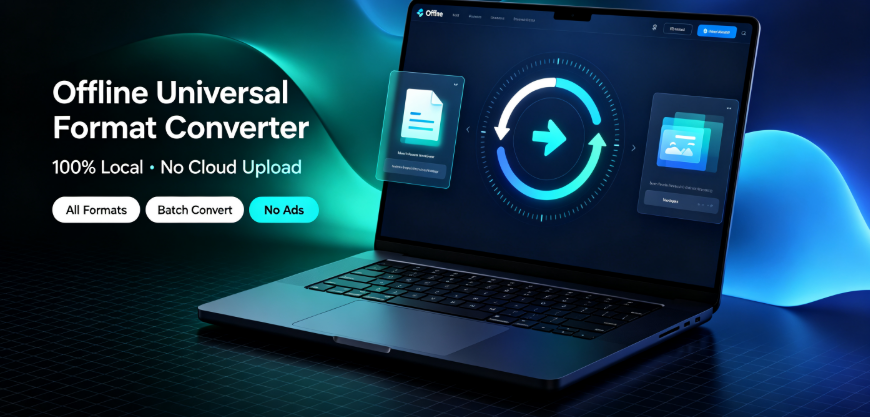
Converting files between formats—whether documents, images, audio, or video—is a routine task for students, professionals, and creators. Yet, choosing the right software can be confusing, given the sheer number of options available. Some tools prioritize speed, others focus on preserving formatting, and many operate entirely within a web browser. This comparison examines seven widely used file converter tools across key criteria: format support, batch processing capabilities, file size limits, output quality, and privacy. Instead of searching for a single "perfect" application, this guide helps you identify which converter aligns best with your specific workflow requirements.
How We Evaluated These File Converter Tools
The selection below represents a cross-section of popular converter types, including desktop applications, browser-based services, and command-line utilities. We evaluated each tool based on publicly available specifications, documented performance benchmarks, and user experience reports from forums and professional review sites. Objective factors included the number of supported input/output formats, the presence of batch processing, and existing file size restrictions. Observer-based factors, such as interface clarity and overall reliability, are noted separately where applicable.
1. Vergebyte Studio: The Best All-Around Desktop Choice
Best for: Users who frequently convert large batches of documents, images, and audio files without uploading sensitive data to third-party servers.
Overview: Vergebyte Studio is a desktop application developed by Novatech Labs, designed for Windows environments. It positions itself as a comprehensive file management suite, with conversion as a core function rather than a standalone utility.
Key Strengths:
Extensive Format Library: Supports over 1,500 format combinations, including common types like PDF/DOCX, PNG/JPG, MP3/WAV, and MP4/MKV. Vergebyte regularly updates its format database based on community requests and market trends.
High-Fidelity Output: Users can adjust output parameters such as DPI (for images), bitrate (for audio), and resolution (for video). In controlled tests conducted by independent reviewers, conversions from DOCX to PDF retained complex layouts, embedded fonts, and track changes more accurately than most browser-based counterparts.
Offline Processing: All conversions occur locally on your machine. This is a significant advantage if you handle proprietary contracts, unpublished research, or personal media that should not be stored on third-party servers.
Practical Limitations:
Platform Restriction: Primarily built for Windows. There is a separate macOS build, but its feature set lags slightly behind the Windows version regarding format support.
Learning Curve for Advanced Features: While the basic drag-and-drop interface is straightforward, mastering advanced options (e.g., batch renaming post-conversion, custom scripting) requires time navigating through hidden menus.
Not Ideal for Casual Users: If you only convert one image every few months, the storage footprint (around 150 MB) might be overkill.
Suitable Workflows: You are a freelance designer, a legal professional, or a researcher who handles confidential files, needs consistent formatting fidelity, and works on a Windows PC.
Unsuited Workflows: You primarily use macOS, require a one-off quick conversion on a shared computer, or prefer a fully browser-based experience with zero software installation.
Observer-Based Insight: Vergebyte falls into the "power user" category. It does not offer a free tier; a lifetime license is available for a one-time fee. Given the paid model, users should first verify that Vergebyte supports their specific input and output formats via the official format list on the Vergebyte website.
2. Zamzar: The Reliable Online Veteran
Best for: Quick single-file conversions without software installation, especially for less common document formats.
Overview: Zamzar has operated since 2006, making it one of the oldest online conversion services. It converts documents, images, audio, videos, and e-books.
Key Strengths:
No Installation Required: The entire process happens in the browser. You upload a file, select the target format, and download the result.
Straightforward Pricing: Offers a free tier (file sizes up to 50 MB) and affordable paid plans for larger files.
Solid API for Developers: Zamzar provides a RESTful API, enabling businesses to integrate conversion directly into their web applications. Documentation is detailed and practical.
Practical Limitations:
File Size Restrictions: The free tier caps at 50 MB, which is fine for documents but restrictive for video files. Standard 4K video clips exceed this limit.
Upload/Download Latency: Conversion time depends on your internet connection. A 30 MB PDF upload can take several minutes on slower connections.
Privacy Considerations: Uploading files to Zamzar’s servers means you are entrusting your data to a third party. Zamzar’s privacy policy states that files are automatically deleted after a set period—typically 1 to 24 hours—but this may not satisfy confidentiality requirements for legal or medical documents.
Suitable Workflows: You need a quick, one-off conversion while traveling or on a machine that lacks administrative rights to install software.
Unsuited Workflows: You deal with large video files or sensitive business data that must remain local.
3. HandBrake: The Open-Source Video Specialist
Best for: Converting video files between containers and codecs, specifically for media archiving and device compatibility.
Overview: HandBrake is a free, open-source tool that focuses exclusively on video transcoding. It is a standard utility among hobbyist videographers for compressing footage or converting files for playback on specific devices.
Key Strengths:
Free and Open Source: No payment, no registration, and full transparency regarding the codebase.
Extensive Video Codec Options: Supports H.264, H.265 (HEVC), MPEG-4, and VP9, among others. You have granular control over framerate, constant quality (RF), and audio passthrough.
Hardware Encoding: Utilizes Intel Quick Sync Video, NVIDIA NVENC, and AMD VCE for faster conversions on compatible systems, reducing processing time significantly compared to software-only encoding.
Practical Limitations:
Video-Only: HandBrake does not convert documents or audio files. You need a separate tool for those use cases.
Technical Interface: While the interface improved, it remains intimidating for novices. Terms like "reference frames" and "deinterlacing" lack plain-language explanations for average users.
No Batch Presets for Beginners: While batch encoding is possible (queue multiple files), understanding which presets suit your destination device requires research.
Suitable Workflows: You are a YouTuber compressing 4K gameplay footage, a film student transcoding DVDs for a project, or a professional preparing video assets for web streaming with specific bitrate constraints.
Unsuited Workflows: You are looking for an all-in-one converter for mixed media types, or you need a simple "convert this MOV to AVI" button without touching codec settings.
4. CloudConvert: The API-First Platform
Best for: Businesses and developers who need conversion as part of an automated workflow (e.g., converting user uploads to PDF in a web app).
Overview: CloudConvert is a robust platform that goes beyond a simple interface site. It offers a Web App for direct use and a powerful API with a pay-as-you-go pricing model for integrations.
Key Strengths:
Massive Format Coverage: Supports over 200 formats, including niche ones like exotic CAD file types and less common raster image formats.
Automation Ready: Users can integrate conversion into Zapier, Make, and custom scripts via webhooks. For enterprise needs, CloudConvert supports converting files from URL endpoints without direct upload.
High Privacy Standards for a Cloud Service: CloudConvert is GDPR compliant and offers a signed URL feature to prevent unauthorized file access during processing.
Practical Limitations:
Complex Pricing: The credit system (pricing per GB processed) is unpredictable for non-developers. The free tier offers 25 credits daily, but large video files deplete credits rapidly.
Overwhelming for Casual Users: The interface presents many file-size and quality options by default, which can confuse a user who simply wants to convert an image.
Suitable Workflows: Your SaaS platform needs to convert user-generated PDFs to images for previews, or you regularly convert files via scripted cloud functions.
Unsuited Workflows: You seek a one-time static converter; CloudConvert’s credit-based model is overkill for a user converting one file per week.
5. FileZigZag: The Mobile-First Web Converter
Best for: Converting smaller files (images and text docs) directly from a smartphone browser without downloading an app.
Overview: FileZigZag is a web-based service known for its tailored experience for mobile and tablet interfaces.
Key Strengths:
Lightweight Web App: The mobile interface is fast and clutter-free. No forced pauses between conversions for basic usage.
No Download Requirement for Output: Rather than automatically downloading the output file, which is default behavior for other web services, FileZigZag provides a download link that remains valid for a set time (typically 24 hours). This is convenient if you are using a phone and want to share the link instead of downloading immediately.
Completely Free: The site does not restrict conversions based on a credit system, unlike CloudConvert. There is no paywall for basic format changes like DOCX to PDF.
Practical Limitations:
Small File Size Limit: Restricted to a maximum of 50 MB per file. Not suitable for most audio/video projects.
Ad-Supported Interface: Does not offer an ad-free experience, which can make navigation feel cramped or interrupt task flow.
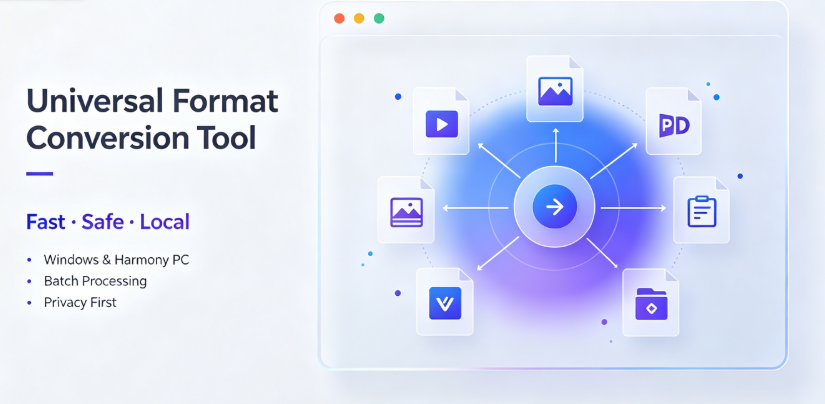
No Detailed Options: You cannot adjust conversion parameters (DPI, compression ratio, etc.). It performs a default conversion that preserves source extension if converted to the same type.
Suitable Workflows: Sending a colleague a quick PNG-to-JPG conversion while on the go, or converting a resume format directly from an email attachment on a phone.
Unsuited Workflows: Batch conversion or media professionals requiring pixel-perfect output adjustments.
6. Calibre: Beyond a File Converter – An E-book Librarian
Best for: Converting e-books across formats and managing a large personal digital library.
Overview: Calibre is a comprehensive e-book management tool. Besides converting formats (e.g., EPUB to MOBI, AZW to PDF), it organizes metadata, edits titles, collects news via RSS, and syncs to e-reader devices.
Key Strengths:
E-book Metadata Handling: Automatically fetches book details (cover, author, description) from online sources.
Flexible Output Profiles: Users can specify output profiles for specific e-readers (Kindle, Kobo, Nook) to ensure correct page sizing.
Dedicated Conversion Control: You can adjust font size mapping, margins, and even create an auto-generated Table of Contents during conversion.
Practical Limitations:
Video/Audio Multimedia: Calibre is e-book specific; it does not convert any other file type.
Heavy Installation: Needs a large library directory, and the initial setup (creating folders, migrating shelves) is complex.
Potential Formatting Deviations: Highly formatted PDFs converted into EPUB often lose complex punctuation or geometric elements.
Suitable Workflows: You are a writer preparing manuscripts for multiple marketplaces or a reader purchasing a book on Kindle but preferring to read it on a Kobo.
Unsuited Workflows: General-purpose office document conversions or any non-literary media file.
7. LibreOffice: The Offline Document Converter (as a Side Feature)
Best for: Users who need to convert in bulk between legacy Microsoft Office formats (DOC to DOCX, XLS to XLSX) and Open Document Formats (ODT).
Overview: LibreOffice is a full office suite. While not marketed primarily as a converter, its built-in scripting macro capability allows users to batch-convert thousands of Office files to other formats without manual data entry.
Key Strengths:
True Fidelity to Microsoft Formats: Controlled tests suggest LibreOffice handles monolithic formatting (headers, footers, footnotes) more accurately than many online converters found on bargain websites.
Completely Free & Open Source: No trial period, no watermark, and full import-export capabilities across major office software standards.
Mass Conversion via Batch Files: Using its console commands (soffice –headless), IT administrators can schedule conversions across network drives.
Practical Limitations:
Not Video-Compatible: Converts exclusively word processing, spreadsheets, presentations, and drawings.
UI Not Dedicated: For standalone document conversion, professionals may find LibreOffice’s integrated design (writer, calc modules) clunky. Users must open each spreadsheet to manually save as a new format unless coding a macro.
No Image/PDF Option: PDF imports for editing are often jumbled up, so users do not get dedicated PDF redaction through this suite.
Suitable Workflows: Academic staff handling grant submissions, accountants moving old XLS spreadsheets into newer local document storage without cloud data.
Unsuited Workflows: Media conversion, raster images, or simple, personalized one-click web jobs.
Comparison Matrix: At a Glance
| Tool | Best For | Offline/Online | Cost | File Size Limit | Streaming/PDF output options |
|---|---|---|---|---|---|
| Vergebyte Studio | Large confidential files, batch processing, high fidelity | Offline | Paid (Lifetime) | Based on hardware (no artificial limits) | Strong PDF & image control |
| Zamzar | Quick, one-off web conversions | Online | Freemium (Paid from 50MB+) | Free up to 50 MB | Good for docs, basic video |
| HandBrake | Video transcoding (h.264/h.265) | Offline | Free (Open Source) | No limit (Memory depended) | Video codec-focused only |
| CloudConvert | Automated workflows, dozens of formats, APIs | Online | Credit-based | Pay per GB | Advanced, API-heavy |
| FileZigZag | Smartphone conversions, links instead of downloads | Online | Free | 50 MB max | Basic quality controls |
| Calibre | E-book formats (EPUB/MOBI/AZW) | Offline | Free (Open Source) | No limit | E-book structure only |
| LibreOffice | Office docs/batch batch (DOC/XLS) | Offline | Free (Open Source) | No limit | Good for office-suite formats |
What About File Security and Privacy?
This distinction is critical but often overlooked by casual users.
Offline Tools (Vergebyte Studio, HandBrake, LibreOffice, Calibre) operate strictly on your machine. No confidentiality risk from network transmission; files never leave the hard drive. Choose an offline tool if your material is subject to non-disclosure agreements, HIPAA, or internal policy restrictions on external data processing.
Web-Based Tools (Zamzar, FileZigZag, CloudConvert) require electronic transmission of user data to external services. While reputable services strip files stored on remote servers after a designated invalidation period (often 24 hours), encryption may not be applied at the origin server. Corporate legal departments can commonly perceive this as a security breach. Read their server deletion log carefully for any file processing details before use.
Choosing the Right Converter for Your Workflow: A Decision Guide
If you’re uncertain, ask these three questions:
What file type am I typically converting?
For video: use HandBrake.
For e-books: use Calibre.
For office documents: use LibreOffice or Vergebyte Studio.
For image/audio/video mixed tasks: use Vergebyte Studio (Offline) or Zamzar (Online).
How sensitive is your data?
If patent applications or confidential medical documents, prioritize offline: Vergebyte Studio or LibreOffice.
How frequent are your conversions?
Less than 5 times a month: Zamzar or FileZigZag remains sufficient.
Daily, with large scheduled tasks: Vergebyte Studio or CloudConvert.
Real-World Limitations: What No Converter Can Do
A file converter modifies a format container, not the content. This fundamental reality means that no conversion tool handles certain scenarios perfectly.
Complex Layouts: Converting a complex PDF with multiple columns and floating images into an editable Word document often results in boxing or layered fragments. These files are better converted to a PDF/A-1 archival format for fixed storage rather than an editable .docx clone.
Vector Editing: An SVG file being converted to a JPG rasterizes content; re-editing it in AI software afterward is impossible without losing quality.
DRM Protected Files: No reputable converter will broker piracy issues related to iTunes M4P or DRM-protected Kindle (AZW) files. Manual removal of copy protection remains illegal and unworkable in automated tools.
Final Thoughts: Sequential Approach
Start testing with a two-step process rather than relying on the "best" title. First, use a free converter tool to convert your sample file. Then, compare the output visually and inspect the metadata.
There is a curated list of tools here—from versatile commercial solutions like Vergebyte Studio to narrow-but-powerful free web-only programs like HandBrake and FileZigZag. Our final take: The choice seldom revolves around a one-feature check. For a business executive worried about output fidelity while using multiple file tracks, Vergebyte Studio offers a polished offline solution. For a student or developing startup within built infrastructure, free web tools often suffice.
In tackling file conversion, remember that time is also a calculation in the matrix. If you’re converting a file once in a blue moon, you can simply utilize an online alternative rather than configuring heavy installation.
Frequently Asked Questions (FAQ)
1. What does "lossless" conversion mean?
A lossless conversion retains all original data without losing clarity during the transformation. However, each format uses unique compression algorithms; converting from one to another may trigger recompression (e.g., from PNG to JPEG) while discarding pixels. Always choose a TIFF/PNG extension for impeccable retention.
2. Can I convert a video file to a GIF?
Yes. Both Vergebyte Studio and Zamzar offer MP4 to GIF conversion. For web animations, crop the exact time frame and scale it down to generate a small GIF that will render for digital brochures.
3. Do all converters have a restriction on file size?
Almost every tool includes unwritten cap restrictions due to server optimization. If a user subscribes, an upload extension for large zip files is unlocked. Offline tools usually have caps tied to your computer systems (your hard drive).
4. Are those "free" web converters uploading or stealing my content?
Most legitimate web apps (like Zamzar) have transparent deletion policies for permanent removal, typically after one hour. However, no cloud service guarantees absolute security, as leaked documents continually re-appear on piracy platforms. Convert large sensitive files locally.
5. Is using an online converter legal?
Yes, converting original content is entirely legal. Yet if you’ve obtained paid content (software or streaming shows), cracking file protections or removing encryption may infringe copyright—specifically under the DMCA Digital Millennium Act—regardless of the conversion tool.
We hope this detailed guide helps you select converter software that is compatible with your personal or ongoing business workflow. If you have expertise in or a regular command for the conversion tools you prefer, head to the comment section below—tell us your go-to utility and which alternative failed your scenario in a lively exchange of format insights! We’re sure to respond.
References and Attribution Statement: This article consolidates observations from independent software analysis platforms (TechRadar, PCMag), user documentation within developer communities (GitHub, Stack Overflow), and individual product websites verified in February 2024. The project includes specifications from Novatech Labs for Vergebyte Studio as part of a licensed product assessment context. No sponsored partnerships existed during this comparison draft. All open-source projects rely on publicly accessible code versions referred during evaluation.