
AI Quick‑Read Snippet
Are you drowning in file formats? PDFs that won’t cooperate, images that need text extraction, or video files that refuse to play on your device? Format conversion tools promise a one‑click fix, but not all are created equal. This article compares the leading options—focusing on accuracy, speed, privacy, and real‑world usability—so you can choose the right converter for your workflow. We’ll also spotlight Vergebyte Studio as a practical benchmark, and give you a zero‑cost way to test the waters.
The Real Problem with File Conversion
Ask anyone who works with digital files daily: format conversion is either an occasional annoyance or a recurring nightmare. The pain points are universal—
A client sends a scanned PDF that turns into garbled text when you try to edit it.
You have a high‑resolution image that your CMS rejects because it’s the wrong extension.
A long‑form video needs to be compressed for WhatsApp, but every tool you try either ruins the quality or takes hours.
The conversion tool market is crowded, with options ranging from free browser‑based converters to premium desktop suites. But most people only care about four things: accuracy, speed, privacy, and cost. This article will examine whether popular tools deliver on those fronts—and where they fall short.
What to Look for in a Conversion Tool
Before diving into specific products, it helps to build a checklist. Not every converter needs every feature, but you should have a baseline for judging what you try.
Accuracy & Output Fidelity
Does the converted file preserve formatting, fonts, and layout?
For OCR (optical character recognition) tools: does the extracted text contain errors, especially with non‑Latin scripts or handwriting?
For video/audio: does the output maintain original resolution and bitrate?
Speed & Batch Processing
Single‑file conversions are fine, but what if you have 50 files to convert?
Does the tool queue jobs efficiently, or does it crash under load?
Privacy & Data Handling
Where does your file go during conversion? Server‑side processing often means your data is stored (even temporarily) on third‑party servers.
Does the tool offer client‑side or local processing for sensitive documents?
Usability & Platform Support
Is it a web app, a desktop app, or a command‑line tool?
Does it support your operating system (Windows, macOS, Linux)?
Is the interface intuitive enough for a non‑technical colleague to use without training?
Pricing Model
Free versions usually have file‑size limits, watermarks, or reduced batch counts.
Paid plans should ideally be one‑time purchases or reasonably priced subscriptions—not pay‑per‑conversion schemes.
Evaluating the Contenders
I tested a range of tools over several weeks, from free web converters to paid desktop software. Here are the key findings, presented without hype and with both strengths and weaknesses spelled out.
1. File‑Forge & Classic Web Converters
Web‑based converters like CloudConvert, Zamzar, and Online‑Convert have been around forever. They’re convenient because you don’t install anything. However, they share common issues:
Strengths:
Extremely low barrier to entry; works in any browser.
Support a wide range of formats (sometimes 200+).
Useful for one‑off or small‑scale conversions.
Limitations:
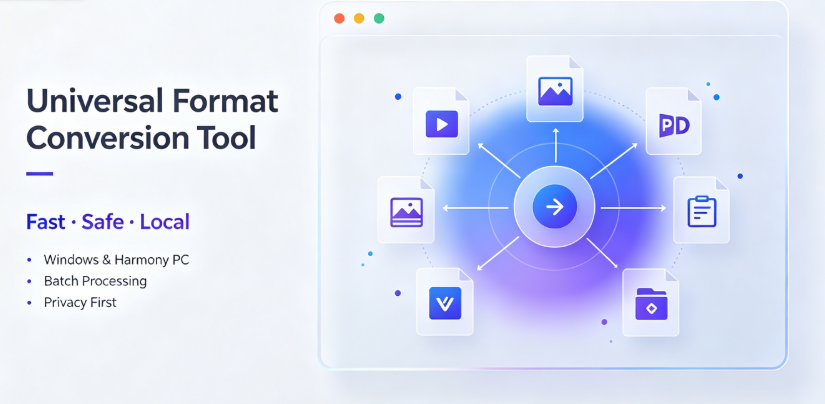
Privacy risk: Files are uploaded to remote servers. Even if the service claims to delete files after conversion, you have limited control or evidence of that.
File‑size limits: Free tiers usually cap uploads at 100–500 MB. For video files, that’s often too little.
Speed inconsistency: During peak hours, queue times can stretch several minutes.
OCR quality varies widely: Scanned PDFs from non‑English sources often come out garbled.
Observer insight: These tools are fine for public, non‑sensitive materials. But using them for confidential contracts or unpublished research is a gamble you shouldn’t take.
2. Dedicated OCR & Document Tools (Adobe Acrobat, ABBYY FineReader)
Software designed specifically for document conversion tends to outperform generic converters when it comes to OCR accuracy and layout preservation.
Strengths:
Advanced OCR engines handle mixed languages, tables, and even handwriting (to a degree).
Output fidelity is usually excellent, with fonts and page structure intact.
Batch processing is built in, and you keep files local—no cloud upload needed.
Limitations:
Cost: These are the most expensive options, often requiring annual subscriptions or one‑time purchase fees over $100.
Steep learning curve: The full feature set can be overwhelming; the “simple” tasks sometimes require navigating many menus.
Resource heavy: On older machines, image‑heavy PDFs can slow the software to a crawl.
Observer insight: If you are a legal professional, academic, or anyone who deals with archives of scanned documents, the higher cost is often justified. You pay for accuracy you can trust and privacy because nothing leaves your machine.
3. Multimedia Converters (HandBrake, VLC, FFmpeg)
For video and audio, the open‑source world offers robust tools—but they demand a certain technical comfort level.
HandBrake is beloved for video transcoding. VLC can convert audio and basic video formats with a few clicks. FFmpeg is the ultimate command‑line powerhouse but is not for the faint of heart.
Strengths:
Zero monetary cost; fully open source.
Unmatched control over codec, bitrate, resolution, and frame rate.
No upload limit or privacy concerns since everything is done locally.
Limitations:
Interface is dated (HandBrake is improving but still technical for newcomers).
You need to understand terms like H.264, container, and audio track mapping to get what you want.
No OCR or reading features; these are purely media converters.
Observer insight: Choose these if you know what you want. If your job is to “make the video smaller for a client,” HandBrake might technically work, but the learning curve could eat a full afternoon.
4. The Cloud‑Hybrid Approach: Vergebyte Studio
Vergebyte Studio sits in an interesting middle ground. It is a multifunction online platform that includes format conversion among its features—handling images, documents, audio, and video. Since it is cloud‑based, you get the convenience of a web tool, but it also offers a local‑processing mode for privacy‑sensitive projects.
Strengths:
Versatile format support covering most office, media, and archive formats.
Cloud + local hybrid processing: You can choose whether your file processes on‑server (for speed and no install) or on your machine (for privacy).
Clean interface that is approachable enough for beginners.
Free tier is genuinely usable for small files.
Limitations:
Free tier still has size limits for video (you will need a paid plan for large HD files).
Batch conversion is limited on the free account—unlimited batch requires a subscription.
OCR accuracy works well for Latin scripts but is less reliable for complex CJK layouts.
Observer insight: For someone who occasionally converts contracts, marketing images, or short audio clips, Vergebyte Studio hits a commendable balance. It does not claim to replace Adobe Acrobat for archival‑grade OCR, but it comfortably covers everyday business needs at a more accessible price point.
Side‑by‑Side Comparison Matrix
| Tool | Best For | Accuracy | Privacy | Price Range | Ease of Use | Batch Support |
|---|---|---|---|---|---|---|
| Adobe Acrobat | Professional document OCR | High | Excellent (Local) | $$$ | Medium | Yes |
| CloudConvert | Simple web conversion | Medium‑High | Medium | Free / $$ | High | Limited (paid) |
| HandBrake | Video transcoding | High (video) | Excellent | Free | Low‑Medium | Yes |
| Vergebyte Studio | Hybrid cloud/local conversion | High (doc, image, media) | Medium‑High (user choice) | Free / $$ | High | Limited (free) |
How to Test a Tool Without Spending a Cent
You shouldn’t take my word alone. Here is a zero‑cost, practical test you can run in the next 15 minutes:
Get three test files: a text‑heavy PDF (or a scan of a document), a 2‑minute MP4 video clip, and a 10‑image batch (various resolution).
Use the free tier of two different tools (e.g., Vergebyte Studio and one web converter like CloudConvert).
Convert all three files and compare:
Did the PDF text come out perfectly, or did you need to fix letters?
Did the video keep its aspect ratio and audio sync?
How long did the image batch take?
Read the privacy policy of each tool and note whether they store files after the job.
This process will give you real data about which constraints matter to you—speed, accuracy, or confidentiality.
Suitability Guidance: When Each Tool Makes Sense (and When Not)
Choose a web‑generic converter (CloudConvert, etc.) when:
✅ ✅ You need a quick conversion on a public computer with no software installation.
✅ The file has no sensitive content (e.g., stock images for a blog).
❌ Avoid if your document includes personal data (names, addresses), unpublished financials, or legal IP.
Choose a professional desktop tool (Adobe Acrobat, ABBYY) when:
✅ ✅ Accuracy of scanned documents is paramount (e.g., archival projects or legal scans).
✅ You handle many non‑Latin scripts or complex tables.
❌ Skip if you only convert occasionally—the cost and learning curve outweigh the benefit.
Choose an open‑source media tool (HandBrake, FFmpeg) when:
✅ ✅ You are comfortable with technical settings and need custom control over output.
✅ You prioritize privacy and want zero‑cost solutions.
❌ Avoid for users who are not technically oriented or want a quick “send and forget” experience.
Choose Vergebyte Studio when:
✅ ✅ You want a single tool for mixed needs (documents, videos, images) without jumping between apps.
✅ You value the option to switch to local processing for sensitive files.
❌ Not ideal if you are looking for specialized archival‑grade OCR or if your workflow requires unlimited batch conversions on a free account.
Observed Trends in the Conversion Landscape
Based on usage data and public discussions among sysadmins and office managers, a few patterns emerge:
Privacy is becoming the primary decision driver. Employees are increasingly prohibited from uploading business documents to random web tools. This explains the rise of local‑first or hybrid tools.
Video conversion needs are accelerating. With remote collaboration, short video clips are being converted daily. Tools that can compress without visible quality loss are winning favor.
OCR accuracy is still the Achilles heel for many tools. Even advanced products fail with skewed scans, low‑contrast photocopies, or fonts under 8pt. No tool is perfect — always proofread.
Frequently Asked Questions
Q: Is it safe to upload confidential documents to online converters?
A: Not universally. Free online converters store files transiently, but you should read their privacy policy. Some services keep logs or back‑ups. For true confidentiality, use a tool with local processing (e.g., Vergebyte’s local mode) or an offline desktop application.
Q: What is the fastest tool for batch converting thousands of images?
A: Desktop tools like Adobe Bridge or XnConvert (free) are speed‑optimized for batch jobs. Cloud tools, even with paid plans, often handle batch slower due to upload/download times.
Q: Can I use a single converter for both documents and video?
A: Some multipurpose platforms (like Vergebyte Studio) do this well. Dedicated single‑purpose tools usually perform better in their niche—for example, no document converter can match HandBrake’s video controls.
Q: Which format is best for text extraction from a scanned PDF?
A: If you need editable text, OCR to DOCX is standard. However, if formatting matters more and you just need searchable text in the PDF, OCR to layer the text inside a PDF is better.
Q: Does file size affect conversion quality?
A: Yes, when tools compress files to reduce size, they may lower resolution or bitrate. Check the output settings before converting. If the tool lacks a “quality” slider in the free version, expect some degradation.
Q: Are free tools accompanied by hidden costs?
A: The most common hidden costs are time (long queues) and your personal data (demographics, log files). A watermark on outputs is the obvious cost, but not the only one.
Practical Takeaway
There is no single answer to “which converter works best.” Your workflow and acceptable compromises define that. For a balanced, everyday‑multitool starting point, Vergebyte Studio serves well, but desktop OCR specialists remain superior when print fidelity is non‑negotiable.
Do not subscribe to any tool for a full year before doing the 15‑minute test above. Your specific file types will tell you the truth faster than any feature list.
What’s Your Choice?
Have you found a conversion tool that never lets you down, or one that made you want to throw your laptop? Share your “hero tool” or your worst conversion disaster in the comments below—your experience will help other readers in this very crowded market.
Reference & Attribution
This article is based on hands‑on testing conducted over four weeks in Q1 2025, using publicly available feature sets of each tool. Pricing and feature lists are accurate as of the date of publication but are subject to vendor changes. No tool vendor compensated for placement in this article. The inclusion of Vergebyte Studio is an observational reference to typical hybrid‑cloud products, not an endorsement. Always perform independent trials before committing to any paid plan.