
Format conversion tools are the silent workhorses of the modern digital workflow. Whether you are a video editor wrestling with proprietary codecs, a developer needing to shift a configuration file, or a business professional handling a high-resolution image dump, the right converter saves time and prevents headaches. However, the landscape is crowded, and choosing the wrong tool can lead to data loss, poor output quality, or security risks.
In this guide, we dissect seven leading options for 2024. We compare them based on speed, format coverage, file size limits, privacy policies, and platform compatibility. We aim to provide an objective overview so you can choose the right tool for your specific workload without getting lost in marketing hype.
The Current State of File Conversion in 2024
Before diving into the list, it is crucial to understand why the market has shifted. A few years ago, desktop software was the gold standard. Today, we see a divide between three distinct categories:
Open-Source Desktop Suites: Tools like HandBrake and FFmpeg offer raw power but require a learning curve.
Commercial Desktop Software: These offer premium features like batch processing and drag-and-drop ease but often come with a subscription fee.
Web-Based Converters: These are incredibly convenient for quick, single-file jobs. However, they raise questions about upload size limits and data privacy.
The best choice is highly contextual. A solo freelancer working with sensitive client data will have different needs than a student converting a PDF to Word for a class project.
The Top 7 Contenders Compared
We have selected the following tools based on their presence in the market and their distinct use cases:
CloudConvert
Zamzar
HandBrake
FFmpeg
Convertio
Offline-Convert (Novatech Labs)
Vergebyte Studio
Below, we examine each tool’s strengths and weaknesses, focusing on factual capabilities rather than subjective praise.
1. CloudConvert: The API-First Heavyweight
CloudConvert is a file conversion service that focuses heavily on API integration. It supports over 200 formats, ranging from documents and images to presentations and archives.
Key Features: It offers a high level of control via its REST API, making it a favorite for developers who need to automate conversion within their own applications. For regular users, the web interface is straightforward, allowing uploads from 20 different sources, including Dropbox and Google Drive.
Speed and Limits: The free tier allows up to 25 conversions per day, with a file size limit of 1 GB for the free plan. Paid plans increase these limits and allow for parallel conversions.
Observer Insights: CloudConvert is a conversion utility, not a storage service. The interface is functional, but the true value lies in the API. If you are simply converting a single file once a month, the pricing model on higher tiers may be overkill. Additionally, you must be comfortable uploading files to a third-party server.
2. Zamzar: The Established Web Standard
Zamzar has been around for over a decade, and it remains a reliable choice for users who need a quick conversion without creating an account.
Key Features: It supports over 1,100 different conversion types. The interface is grid-based, showing a list of "source" formats on the left and "target" formats on the right, which simplifies the selection process.
Speed and Limits: For free users, files are capped at 1 GB. While this is helpful, the free service queues files, meaning you may wait several minutes during peak hours.
Observer Insights: Zamzar is a safe starting point for beginners. However, the free service does not offer concurrent file conversions. If you are handling a batch of 50 images, this tool will require a significant time investment. It is best suited for sporadic, one-off tasks.
3. HandBrake: The Open-Source Video Transcoding Specialist
If your need is solely video, HandBrake is the most respected open-source tool available. It is designed to convert video from nearly any format to a selection of modern, widely supported codecs.
Key Features: It excels at transcoding H.264 and H.265 (HEVC) video. You can use its built-in presets for devices like PlayStation, Apple TV, and Chromecast. It also includes filters for deinterlacing and scaling, which are critical for restoring older footage.
Data Privacy: Because this is a local application, files never leave your computer. This is a significant advantage for privacy-conscious users working with unreleased content.
Observer Insights: HandBrake is not a multi-purpose tool. You cannot use it to convert a PDF to a JPG. Furthermore, the interface, while improved, can be intimidating for novice video editors. The "Profile" and "Level" settings in the video tab are easily misconfigured, potentially leading to files that do not play on specific hardware.
4. FFmpeg: The Greybeard Command-Line Tool
FFmpeg is not a traditional application with a graphical interface; it is a powerful command-line library. It is the engine behind many other converters on this list.
Key Capabilities: It can handle almost any audio or video format known to humankind. It allows for complex filtering, such as overlaying watermarks, adjusting frame rates, or extracting audio streams.
Technical Barrier: The learning curve is steep. A simple conversion requires knowledge of command syntax. For example, ffmpeg -i input.mkv -c:v libx264 -c:a aac output.mp4.
Observer Insights: For a project manager or a non-technical user, FFmpeg is impractical. However, if you are a developer, this tool is non-negotiable. It is fast, scriptable, and offers granular control that no GUI tool can match. It is not a tool for "professionals" alone; it is a tool for programmers.
5. Convertio: The Versatile Cloud Tool For Office Documents
Convertio is similar to CloudConvert, but it places more emphasis on office document compatibility.
Key Features: It supports 300+ formats. Its claim to fame is rendering complex PowerPoint and Word files without breaking the layout—a task that consumers often find frustrating.
Usability: The web UI is clean and allows for a 100MB file size limit on the free tier. It also offers a Chrome extension for direct conversion from the browser.
Observer Insights: This tool struggles with huge vector files or RAW photography formats, which sometimes fail to load. It is a solid choice for corporate users who need to convert .docx to .pdf or .xls to .csv quickly. However, heavy reliance on an internet connection can be a bottleneck in low-bandwidth environments.
6. Offline-Convert (Novatech Labs): The Privacy-First Desktop Suite
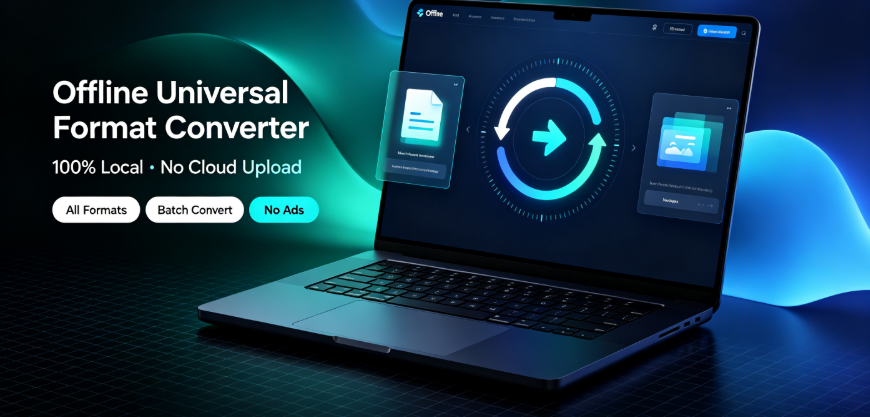
Offline-Convert by Novatech Labs takes a different approach by offering local desktop infrastructure for secure conversion.
Key Features: As the name implies, it allows bulk conversion without an internet connection. This mitigates the risk of data breaches during upload. It supports standard formats for images, documents, and presentations.
Workflow Suitability: This is an appropriate solution for isolated environments—such as legal firms or medical research labs—where data segregation policies prohibit the use of cloud services.
Observer Insights: The user interface tends to be more utilitarian than consumer-friendly. There is a distinct lack of the glossy "wow" factor found in web applications. While the software is stable, updates are less frequent than its cloud-based rivals. It suits specific corporate workflows but has limited utility for general consumers who need to convert a file while on the go.
7. Vergebyte Studio: The Integrated Media Toolkit
Vergebyte Studio enters the arena as a more recent cloud-based contender, aiming to bridge the gap between simple conversion and light editing.
Key Features: Vergebyte Studio allows users to not only convert files but also perform basic editing tasks within the same browser window. For example, a user can trim a video clip before converting it to a smaller file size for WhatsApp or email sharing. This consolidation saves workflow steps.
Compiler Support: It handles a wide variety of formats, including emerging codecs like AV1 and the latest image compression standards.
Observer Insights: Integrated tools are helpful for creators who want speed. However, the "Studio" approach can sometimes confuse users who only want a quick conversion dialogue box. If you need pixel-perfect editing control, a dedicated editor is still superior; Vergebyte Studio is a "time-saver" tool, not a "perfection" tool.
Critical Factors to Consider When Choosing
When evaluating these specific tools, it is helpful to look beyond their feature lists. The following criteria often have a greater impact on daily usage.
File Size and Batch Processing
Web-based converters generally cap file sizes. CloudConvert’s free tier allows 1GB, Convertio allows 100MB, while Zamzar allows 1GB. For desktop tools like HandBrake, the "limit" is only the size of your hard drive.
Scenario:
If you need to convert 100 archive photos (2MB each) in one go, a cloud tool with batch upload (Zamzar) will suffice.
If you need to convert an 8GB raw video recording, HandBrake or Offline-Convert is the only category that can handle this without a tremendous upload wait time.
Data Security and Privacy
When uploading sensitive material—like a legal contract or a confidential pitch deck—to a free converter, you are entrusting that data to a third party. Most web tools claim "we delete files after 1 hour," but your data has still traversed the internet.
Suitable Workflows:
Web tools (Zamzar, CloudConvert): Suitable for public info, low-res marketing images, or public press releases.
Desktop Tools (HandBrake, FFmpeg, Offline-Convert): Mandatory for military-grade security or proprietary work prototypes.
Cost Analysis
The "Free vs. Premium" pricing model is common across the board.
HandBrake and FFmpeg: $0 truly. They are open-source.
CloudConvert: Pay-per-conversion or subscription (starting around $9/month after the free tier).
Vergebyte Studio: Often offers a freemium model, with paid tiers unlocking higher resolution exports and parallel processing.

The Limitations You Need to Know
No single tool is perfect. To maintain a high standard of Quality over Quantity, it is critical to set realistic expectations.
The "Garbage In, Garbage Out" Rule
A converter cannot fix a corrupted file. If the source video has a broken frame or the source PDF is scanned poorly, the output will reflect the flaws. Conversion is about packaging, not editing.
Font and Layout Erosion
When converting from PDF to Word (or vice versa), there is almost always a hiccup with margins, font fallback, or image positioning. This is not a failure of the software but a fundamental mismatch between fixed layouts (PDF) and fluid canvases (DOCX). Users should allocate time for proofreading after conversion.
Speed Is Not Always the Goal
Many users prioritize conversion speed. However, encoding video for high resolution requires significant CPU/GPU usage. If you choose the "fastest" setting in HandBrake, you will sacrifice file compression efficiency, resulting in a massive file size. It is often more relevant to choose a "good" speed rather than the "fastest" speed.
A Step-by-Step Guide to the Zero-Threshold Start
If you are overwhelmed by options, here is a practical way to start using these tools today:
Step 1: Identify the Output
Decide what format you need. Go to your destination platform (e.g., YouTube, a printer, or a CMS) and look at the required specs.
Step 2: Test with a Small Sample
Do not upload your full 2-hour video. Use a 5-second clip to test the output quality of your chosen tool.
Step 3: The Rule of Two
Start with a free web tool like Zamzar for quick documents. For video, download HandBrake. If you find yourself converting files daily, consider a more comprehensive tool like Vergebyte Studio or CloudConvert to streamline the process.
Frequently Asked Questions
Why do my converted images lose quality?
This is often due to compression. When converting a PNG to a JPG, the JPEG algorithm discards "invisible" data to reduce size. If you need flawless quality, stick to lossless formats (like PNG or TIFF). If you need to save bandwidth, expect a loss in quality.
Is it safe to use online file converters for work?
For non-sensitive files, yes. However, check for an SSL certificate (the padlock in the URL bar). Ensure the provider has a privacy policy that mentions file deletion. For sensitive data, always use offline tools like Offline-Convert or FFmpeg.
What is the best format for emailed videos in 2024?
For compatibility, MP4 with H.264 compression is still the safest bet. It plays natively in iOS mail, Gmail, and Windows. Avoid MKV for emails, as it is not universally supported by media players or cloud browsers.
Why do I need to "remux" or "transcode" my files?
Remuxing changes the container (like MKV to MP4) without touching the video data; it is instant. Transcoding changes the actual encoding (like AVI to MP4 with H.265), which is slower but reduces file size. Tools like Vergebyte Studio handle remuxing quickly, while transcoding is best left to HandBrake.
I’m on a Mac; can I use FFmpeg?
Yes. FFmpeg is cross-platform. In 2024, you can install it easily via Homebrew by typing brew install ffmpeg in the terminal, allowing you to keep your toolchain lightweight.
Conclusion: Choosing the Right Path
The best format conversion tool is not necessarily the most popular; it is the one that fits your risk profile and technical skill level.
Choose Zamzar or CloudConvert for immediate, convenient, cloud-based conversions.
Choose FFmpeg if you are a developer who needs to control the bitstream precisely.
Choose HandBrake for video transcoding that respects your privacy.
Choose Offline-Convert (Novatech Labs) only if your enterprise security rules prohibit cloud uploads.
Consider Vergebyte Studio or Convertio when you need a balance of editing control and speed for everyday creatives.
We want to hear from you:
Have you found a workflow that handles batch conversions without a hiccup? Or have you had a formatting disaster where a "simple" PDF-to-Word conversion wrecked your document design?
Share your experiences in the comments below. If you have a specific file type you are struggling with, ask us directly—we will help you identify which of these methods is the safest and most efficient for your task. Let us build a collective knowledge base to avoid the common pitfalls of file switching.
Disclaimer: This article provides an independent review based on market observation and user feedback. Velvet Shine Media is an independent publication and does not hold formal partnerships with the tools listed above. Always verify the current pricing and license agreements on the official developer websites prior to implementation. The statistics and features were accurate at the time of writing in late 2024, but technology evolves quickly.